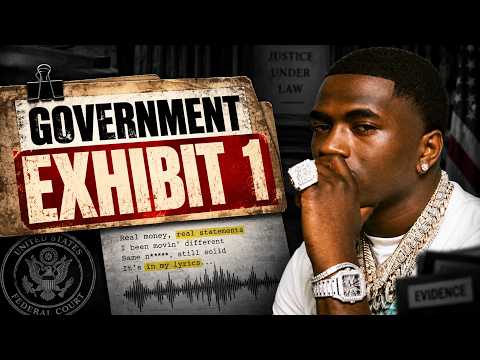
Rapper Bankroll Freddy recently lost his federal appeal, a development that might seem like just another headline in the music industry. But there is one specific aspect of this case that should act as a wake-up call for every rapper, social media influencer, or frankly, anyone who puts their life online. Federal prosecutors successfully used his own music against him at trial, and the 8th Circuit Court of Appeals has ruled that this was perfectly legal. When you move through the federal system, you learn quickly that everything you produce — every thought, every image, every lyric — leaves a digital footprint that the government can use to build a case against you.
The Conviction: 150 Months in Federal Prison
Bankroll Freddy, whose legal name is Freddy Gladden III, was convicted in April 2024. The jury found him guilty of marijuana trafficking, using a telephone to facilitate drug trafficking, and possessing a firearm in furtherance of a drug trafficking crime. While he was acquitted of several other charges, including a specific machine gun count, the damage was already done. He was ultimately sentenced to 150 months in federal prison.
That is 12 and a half years behind bars. It is important to remember that in the federal system, there is no parole. When you are sentenced to 150 months, you are expected to serve nearly every day of that time. The appeal focused on several issues, including concerns regarding the Speedy Trial Act and the length of his sentence, but the most significant takeaway for the public remains the government's creative use of his own artistic output.
How Prosecutors Used His Music
At trial, prosecutors played clips from four of Bankroll Freddy’s performances. It was not a massive haul of content; it amounted to about 30 seconds of total audio. The government did not bring this music to the courtroom to argue that he was simply a gangster rapper who deserved to be locked up based on his genre. If they had, the defense likely would have successfully argued that it was unfairly prejudicial.
Instead, the government took a surgical approach. They argued that specific words used in his lyrics demonstrated that Freddy had intimate knowledge of the exact terminology appearing in their drug and firearm evidence. By isolating these snippets, they transformed his art into evidence of intent and knowledge.
448 and the Glock Switch
To understand why this mattered, you have to look at how the government uses codes and street language. During the trial, the jury heard testimony that the number “448” is slang for a pound of drugs. Prosecutors played a clip where the rapper used that term to show the jury that he understood the language of the trade.
They did the same thing with firearm terminology. The appeals court noted that other lyrics referenced a “Glock” and a “switch” — a device used to make a firearm fully automatic. Because a Glock switch was part of the evidence in his criminal case, the prosecutors were able to bridge the gap between his music and the physical evidence. They successfully moved the needle from “artistic expression” to “demonstrated knowledge.”
The Defense: A Lyric Isn't a Confession
Freddy’s defense team was sharp; they brought in a law professor to serve as an expert witness. This expert explained a concept that most of us in the industry already understand: rappers create personas. They tell stories, they exaggerate, and they utilize the vocabulary of the streets to paint a picture.
His defense argued that just because someone uses a word in a rap song does not mean they are confessing to a crime. You can understand the slang of a trade without participating in that trade. It was a strong, logical argument. However, the legal reality is that a judge’s role is not to determine which narrative is the 'truth,' but to decide if the evidence is admissible for a jury to consider.
That's What Juries Are For
Ultimately, the appeals court ruled that the conflict between the defense’s expert and the government’s theory was a question for the jury to decide. The judges acknowledged that while lyrics can be prejudicial, they are not automatically excluded. Because the government was able to link the lyrics to specific physical evidence, the court found that the jury could decide whether the music proved knowledge or was merely performance art.
This is a brutal reminder for defendants. Juries are made up of everyday people who may not understand the nuances of the rap industry. When a prosecutor stands up and tells a story that links a song to a seized weapon, the jury will often believe the narrative that connects the dots rather than the defense that says, 'It’s just a song.'
How Federal Cases Are Built From Pieces
Having spent time inside the federal system, I have seen exactly how this works. Federal cases are rarely built on one 'smoking gun.' They are built out of thousands of small, individual pieces. A single phone call or a text message usually isn't enough to secure a conviction. A single Instagram post or a rap lyric often isn't enough, either.
But the government is patient. They take a phone call, a text, a photograph, and a lyric, and they stack them together. Once you have enough of these pieces, you stop presenting individual bits of information and start presenting a cohesive story. To a jury, that story starts to look like proof beyond a reasonable doubt.
The Sentencing Wrinkle: Punished for Acquitted Conduct?
One of the most frustrating parts of the federal system is how sentencing works compared to trial. Freddy was acquitted by the jury of possessing a machine gun, and the jury specifically answered 'no' when asked about the Glock switch. However, at sentencing, the judge still considered the condition of the firearm — noting it was missing a back plate — as evidence for sentencing purposes.
Freddy’s team argued that this was essentially punishing him for conduct the jury had already rejected. The 8th Circuit disagreed, ruling that the judge wasn't necessarily saying he possessed the switch, but was acknowledging the technical state of the gun. In federal sentencing, these small distinctions can result in years of extra prison time. This is a common, and often devastating, experience in federal courtrooms.
What Made This Case Different
This case does not mean that every violent lyric is now admissible in every court. The appellate court was careful to note that the trial court did not abuse its discretion because the lyrics were used to prove knowledge of specific terms related to the case evidence. It was the connection, not the content alone, that did the damage.
If the lyrics had been generic 'thug life' statements, they might have been excluded as prejudicial. But by tying the '448' to the drug evidence and the 'switch' to the gun evidence, the prosecutors made the lyrics relevant to the charges. That is the threshold that changed everything for the defendant.
The Lesson for Anyone Who Puts Their Life Online
My advice to anyone involved in the federal system or under investigation is simple: do not assume your content is harmless just because you call it art or entertainment. If you are putting your life online — whether it is on social media, in songs, or in videos — you are creating a potential exhibit for the government.
Prosecutors are looking for intent, knowledge, and patterns. They will scour your digital history to find the missing link that ties a physical piece of evidence to your mental state. As of now, Bankroll Freddy’s conviction and sentence remain in place. His case serves as a sober reminder that when the federal government is involved, your words are never 'just art.' They are always potential exhibits.
This article is for educational purposes and is not legal advice.